Showing posts with label bengali. Show all posts

Wednesday, March 16, 2022

A cat has nine lives, I have many more – 2

This is about another of my near death experiences, also in Kolkata. It was in the 1970s and involved a bus. I did my schooling in St. Joseph's College, an English medium school. My mother tongue is Bengali and my knowledge on it was limited. In college, I faced problems with the language and a pass in it was compulsory for the I. Sc. Exams. The pass mark was 30 percent and I somehow managed to scrape through with 31 percent. This preyed on my mind and I decided to devote some of my time to write in Bengali. I did it on the sly and sent the stories across to a few magazines. And – I struck pay dirt in 1967. That was when I got an employment in HAL Nashik. I was at Howrah Station to catch the train and went to the bookstall to buy some magazines to read during the journey. Believe it or not, one of the magazines had published my story. I needed a breakthrough and this was it.


During one of my visits to Kolkata in the 1970s, I came to know of a magazine that wanted writers. Its address was on the outskirts of the city and I was not familiar with the area. I talked with the locals and got an idea of the locality. I had to take a bus and had to wait for the bus to come along. It was crowded and when I asked for a ticket, I discovered that it was a wrong bus. It had started to move and I tried to get down from the moving bus. I landed on the road and the bystanders helped me to my feet. This could have had serious consequences but I lived to tell the tale of another experience with death.


Popular stories on this and related sites –


A cat has nine lives, I have many more – 1

Old age home for senior citizens

Health is an important issue for senior citizens above 60

Senior citizens in the world of smart phones and credit cards

Bollywood film industry celebrates Holi, the festival of colors, to welcome spring

Uttar Pradesh celebrates Holi, the festival of colors, to welcome spring

Rajasthan celebrates Holi, the festival of colors, to welcome spring

Prince Harry does not have any plan to visit Britain in March

Home delivery cooked meals – an example of work from home

The fast food culture in India

Friday, August 28, 2015

Bengali’s favorite dhokar dalna


Dhokar dalna is a dish loved by Bengalis and, while chana dal can be converted into any number of mouthwatering recipes, the dhokar dalna is in a world of its own – it remains unruffled by the innumerable items that keep sprouting all around it clamoring for attention.
Dhokar dalna, undoubtedly, rules the roost and holds a pride of place in the Bengali cuisine – the place it occupies cannot be taken by any other.
The person who created this wonderful dish is not known, neither is there any explanation of why it is called dhokar dalna. ‘Dhoka’ stands for ‘bluff’ and ‘dalna’ usually means a thick sort of spicy gravy. This part of the nomenclature is understandable but not the ‘dhoka’ part!!
Anyway, preparing this delicious dish is a tedious affair. There are a number of steps involved right from soaking the chholar dal in water and, later, making a paste out of it. To get the proper taste, the paste used to be made on a grinding stone but, with the advent of the food processors, the activity can be offloaded to the gadget. Only – care should be taken to ensure that the paste remains a bit coarse.
Then follows adding spices and drying the paste so that it lends itself to be suitable molded by laying it on a plate and cutting into diamond shapes. Some like it square, others rectangles - the shape does not matter. The next step is to fry these squares or rectangles or diamonds to a brownish color. And, then preparing the gravy and putting the fried dhokas into the gravy.
From the above it is clear that it requires time, patience and, of course, the ability to prepare the dhokar dalna. But, the homemakers of today are busy with their activities of running the house alongside taking care of the children and working in the office. They may have the inclination but do not have the time. They must, at times, feel the absence of elderly ladies in the family. Therefore, when the palate wants the taste of dhokar dalna, they make a beeline for some restaurant.
Incidentally, the basic ingredient of dhokar dalna is the dhoka and, there are shops in Kolkata that sell these packets of ready-mix. There are the ‘best by’ dates indicated and all one needs to do is to prepare the gravy, add the dhokas and enjoy. (to be continued …)
(Image courtesy wikimediacommons.org)


Some more interesting 'must reads'-

Anaconda in a pothole of Bengaluru to galvanize the authorities to act

Cochin airport goes ecofriendly – to become only solar powered airport in the world

V Festival in Chelmsford could face tornadoes, hail and thunderstorms


Ice Cube would love to have dinner with Barack Obama once he leaves White House

Indian names of Pallavi Sharda and Dev Patel in Hollywood film ‘Lion’

Hugh Jackman of Wolverine fame could portray the role of Greek hero Odysseus


White House discloses – 2nd in command of ISIS killed in drone strike in Mosul

Bomb blast outside temple of Lord Brahma in Bangkok leaves at least 27 dead

Scuba diver smuggles cocaine across US-Mexico border via underwater tunnel


Indian kitchens must have ‘besan’

The lost world of ‘kabiraji cutlets’

Growing up days – I begin to go to the daily market

Thursday, August 27, 2015

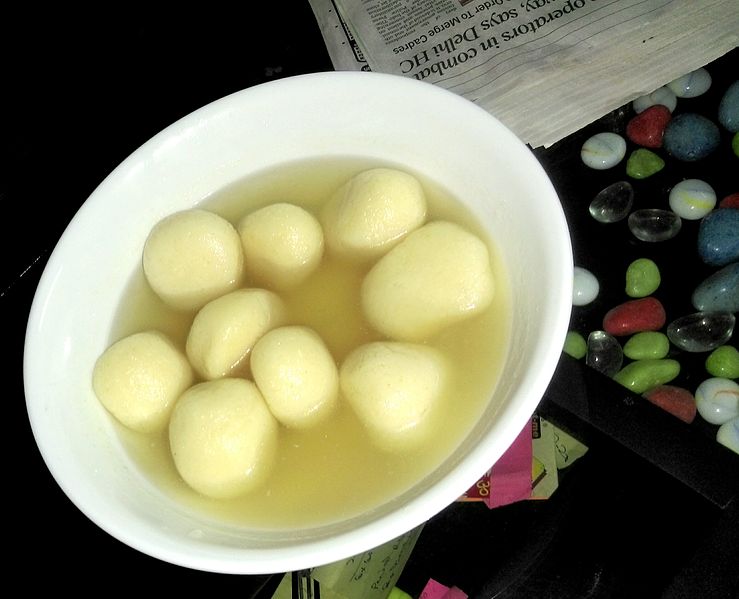
Rasgulla, the juice-dripping sweet that Bengalis swear by


Till now, I knew that the delicious rasgulla was a creation of Bengalis and the credit went to one K C Das who invented these wonderful balls of delight. Its only ingredient was chhana or cottage cheese that had to be cooked in a syrup of sugar. But, Orissa wants to take the credit for being its creator!!
Whatever it may be, creating rasgulla may sound simple but it requires plenty of experience to have the correct density of the syrup and the proper kneading of the chhana. It is mass produced in hundreds in a huge vessel over a coal fire. Nowadays, with the introduction of new and modern gadgets, the equipment have been modified but the process remains unchanged.
The rasgulla are usually an inch in diameter but there are the larger ones that go by the name of Raj-bhog (feast for the King). Here, a stuffing is introduced in the center of the white ball – the stuffing is usually of a paste of almond, pistachio with a small size kishmish in each Raj-bhog. And, the size is bigger.
Yet another variety is the kamala-bhog – this has a tinge of orange color with the essence of orange added in the dough in addition to the orange color.
And, one cannot overlook the smaller size rasgullas that go to create another Bengali favorite – the rasomalai. The rasgullas used in this are really small ones and, the rasomalai is prepared by adding the small ones in a mixture of kheer. This kheer is nothing but milk that is boiled to reduce the volume – as it keeps boiling, it thickens and, there is a new taste that is totally unlike milk. When the tiny rasgullas keep boiling in this kheer, the tiny balls swell and melt when popped in the mouth. One can easily relish a dozen of these tiny rasgullas in the rasomalai.
The popularity of rasgulla can be gauged from the fact that during marriages, there used to be friendly competition among the guests – who can eat how many. Those traditions have vanished because people have become health conscious. Moreover, the serving is done by caterers and, they will serve only as per the preplanned menu. Extra helpings are taboo.
However, all of a sudden, news have emerged that the origin of this beloved rasgulla is not in Bengal but in neighboring Orissa.
Director of K C Das Private Ltd, Sanjoy Das, the fifth generation descendant of Navin Chandra Das family, has clarified that it was the Das family who had created rasgulla made from cottage cheese and dipped in a sugary syrup. But, Orissa claims that the rasgulla originated from the Jagannath Temple in Puri – it had been a part of the religious rituals since the 12th century.
Obviously, experts have to dig up evidence to decide the winner in this battle – till the final decision is known, let us enjoy the rasgulla in all its glory. (to be continued …)
(Image courtesy wikimediacommons.org)


Some more interesting 'must reads'-

Anaconda in a pothole of Bengaluru to galvanize the authorities to act

Cochin airport goes ecofriendly – to become only solar powered airport in the world

V Festival in Chelmsford could face tornadoes, hail and thunderstorms


Ice Cube would love to have dinner with Barack Obama once he leaves White House

Indian names of Pallavi Sharda and Dev Patel in Hollywood film ‘Lion’

Hugh Jackman of Wolverine fame could portray the role of Greek hero Odysseus


White House discloses – 2nd in command of ISIS killed in drone strike in Mosul

Bomb blast outside temple of Lord Brahma in Bangkok leaves at least 27 dead

Scuba diver smuggles cocaine across US-Mexico border via underwater tunnel


Indian kitchens must have ‘besan’

The lost world of ‘kabiraji cutlets’

Growing up days – I begin to go to the daily market

Thursday, August 13, 2015

Joynagarer Moah – a unique sweet of Bengal


There are several food items that are unique to West Bengal and, while others may try to imitate them, their efforts very seldom deliver that which is there in the originals. Bengalis have a sweet tooth and sweets rule the roost – in every lane and by lane, alongside the tea shops there are the shops that sell sweets. The sweets appear to be the same but, each shop has its specific patrons.
Anyway – to return to some sweets that are Bengal’s identity. There is the Joynagarer moah which is available only during the winter months. The reason is the ingredients that go into making these sweets that are the delight of Bengalis. Anyone who is returning from Kolkata during winter would invariably be weighed down by packets of this delicacy.
The moah are made from a special kind of puffed rice that are bound with jiggery – that too special nalen gur which is made out of the juice of palms trees. The juice is collected and boiled over a slow fire till the liquid crystalizes and turns solid. There is a special tact involved and the final product depends on the artist who toils over the fire to create these masterpieces. Machines cannot create these.
There was tis beautiful movie on the subject – it was the 1973 movie Saudagar and its actors were Amitabh Bachhan, Nutan and Padma Khanna.
Anyway, the Joynagarer moah of South 24 Parganas Joynagar district has now won the coveted G I (geographical indication) tag. This tag attaches great prestige to the special sweet that has a very short life and has brought joy to those who make these.
Two more equally unique Bengali sweets are the Mihidana and Sitabhog of Burdwan.
These are under evaluation by the concerned people in Chennai and a decision is expected to be made known soon.
Incidentally, a GI tag is a name or sign used on certain products which corresponds to a specific geographical location or origin. (to be continued …)

Some more interesting 'must reads'-

Take care of the heart – a few dos and don’ts

Chinese research finds that spicy food is the secret to a long life

Swatchh Bharat campaign takes a beating in Delhi itself


Dame Julie Andrews to direct new ‘My Fair Lady’ in Sydney for 60th birthday of Opera Australia

There is a fight scene between Captain America and Spiderman in ‘Civil War’

Shah Rukh Khan’s fond wish - to see Ethan Hunt and James Bond in one movie


Parts of lost plane MH370 of Malaysia Airline washes up on Reunion Island

Niloy Neel, fourth blogger of Bangladesh, hacked to death in Dhaka

Suicide bombers attack Kabul –kill dozens of innocents


A street food named jhal muri

A tribute to Kishore Kumar, the legend, on his 86th birthday

The world of fuchka, golgappa and panipuri

Monday, April 13, 2015

Contract bridge is a good option on Sundays


Addiction to cards has been labeled as an evil and, in Bengali, there is a saying ‘tash, dabah, pasha, shakal karma nasha’ – this means the three vices that affect one’s normal working are cards, chess and the game of dice a-la Shakuni mama in the Mahabharata.
I had not become an addict as such but loved a game of bridge.
I began with auction bridge – that also due to circumstances. I had lost my father and so had a close friend of mine. One evening, as I was sitting with him, his brother-in-law came along. He invited me to a game of auction bridge and when I explained that I did not know how to play it, he brought out a pack of cards and explained.
Then we sat down to a game. It needed a foursome, so my friend’s wife teamed up with her brother and I and my friend got together. That was the beginning. My friend is now settled in Kolkata as is his brother-in-law.
Anyway, later, I switched over to contract bridge and would have regular sessions on Sunday afternoons in my quarter. In those days, mobile phones were unheard of and we would fix the schedule while marketing.
One fine day my friends invited me to accompany them to a night session of contract bridge. It used to be held in the Mitra Vihar club on Saturday nights and would begin after dinner at 10pm. The games went on till early hours of Sunday. Since it was duplicate bridge, it offered a level playing field to all and no one could grumble about bad break of cards or complain of any hanky-panky tricks.
I had, in the meantime, linked up with a regular partner and had devised a bidding system of our own. We wrote the details on a sheet of paper and would leave it on the table for our opponents to refer in case of doubt. Those who played by the standard bidding systems of Goran or Precision, just made a mention of that during the play. But, me and my friend devised out own system – hence had to table it as per tradition.
After gaining experience at Mitra Vihar and then at other venues like the State Bank club in Nashik, we decided to participate in the state level championship. Our HAL Recreation Club was kind enough to sponsor two teams and, it was an experience that I can never forget. (to be continued …)

A few more must reads -

Nashik Kumbhmela 2015 – a once in 12-years pilgrimage

Trip to Nashik should take in Shirdi and the Ajanta and Ellora caves

Nashik, a tourist center with links to the epic Ramayana

Nashik, a tourist center with links to the Mahabharata

Kumbhmela 2015 in Nashik – guided tours to wineries and vineyards

Nashik transforms from a place of pilgrimage to an industrial hub


Pattern of death changing in India – heart and lung related diseases are top killers

Stray dogs attend funeral of Mexican woman who fed them

Nationwide ban on cow slaughter on the cards says Union Home Minister Rajnath Singh

Health tips – lose weight without dieting

Auckland girl sweet talks thief to return stolen mobile phone

Anchovies can boost good cholesterol and reduce risk factors of the heart

Another interesting blog - Violence and atrocities

Another interesting blog - Citizen Journalist

Monday, March 30, 2015

Pitfalls of Temporary Duty – the Delhi-Bareilly experience


As a member of Customer Services it was but natural that I proceed on Temporary Duty to Air Force locations, sometimes at short notice. It began with my first TD to Air Force bases at Bareilly in UP and Tejpur in Assam. I had got a promotion and, while my immediate boss wanted to retain me in the office, his boss wanted that I go to some Air Force base. And, as luck would have it, one of our Service Engineers was retiring and I was asked to take over the inventory from him. He held charge of two bases – one at Bareilly, the other at Tejpur.
The time was December and it was my first ever TD – I expected to get guidance from the officer who was retiring. But, it turned out that he was not happy with our boss because his request for extension had not been approved. Hence, he bore a grudge against him.
Unfortunately, he was a Bengali, hence, my colleague wanted to vent his anger on me.
Anyway, the journey from Nashik Road to New Delhi was uneventful. We had boarded the Punjab Mail and, in those days, there was a First Class compartment. By manipulating with the TTE, my colleague managed to wrangle a couple of berths for us.
We got down at Faridabad and took a cycle rickshaw to the house of my friend’s son in law – it was terribly cold as it usually is in Delhi in the middle of December. The cyclerickshaw-wallahs had covered themselves in blankets and pedaled without removing the coverings. After a north Indian dinner we retired for the night.
Next morning, he wanted to go to the Air Headquarters – to follow up his request for extension. I tagged along with him and, saw some important landmarks of New Delhi. Then we went to the house of another of his son-in-laws in Delhi for lunch. Our plan was to leave for Bareilly by taking a bus from ISBT - accordingly, I arrived at ISBT by evening but my friend was nowhere to be seen. I rang up his daughter and she said he had already left. I was getting in a panic because one bus was getting ready to leave for Bareilly when I saw him coming. (to be continued …)


Another interesting blog - Violence and atrocities

Another interesting blog - Citizen Journalist


Links to some more interesting stories –


Nashik Kumbhmela 2015 – a once in 12-years pilgrimage

Trip to Nashik should take in Shirdi and the Ajanta and Ellora caves

Nashik, a tourist center with links to the epic Ramayana

Nashik, a tourist center with links to the Mahabharata

Kumbhmela 2015 in Nashik – guided tours to wineries and vineyards

Nashik transforms from a place of pilgrimage to an industrial hub


Nine medical students go to Syria, their families try to bring them back

Health tips – lose weight without dieting


My Boss wanted me to become a detective

Auckland girl sweet talks thief to return stolen mobile phone

Anchovies can boost good cholesterol and reduce risk factors of the heart

Tuesday, March 24, 2015

Wing Commander who wore a wig and rode a scooter


Yes, this Wing Commander was the head of Customer Services and my boss. He was a unique person and the more I got to know him, the more was I struck by his methods. He was a Bengali and never spoke in Bengali. He owned a Fiat – an original Italian version. And, he maintained it by himself. If you opened the bonnet, you not find a speck of dust or a drop of oil anywhere. He also owned a scooter and would come to office on the two wheeler. In order to keep his wig from flying off, he used to hold it in place by a pair of goggles that he would place strategically on his forehead – to lock the edge of the wig in place.
This boss was different from others because he could also strum the guitar. This was revealed at the farewell party of a colleague. In order to liven up the evening, he had come with his instrument and sang some of his favorite sings. One of these was – ‘mere piya gaye Rangoon, wahan say kiya hai telephone …’
As I have mentioned earlier, he initially did not give much importance. But, one day, I discovered a letter from the IAF that he had marked to me by name. ‘Ghose, please discuss’. It was a purely technical subject and I discussed with my elderly colleagues on how I should approach the subject. But, their replies did not help. So, I decided to study the subject on my own, and gather as much information as possible.
That took me the rest of the day and next morning, I met my boss after he had settled in.
I narrated to him what I had found out and he appeared to be impressed. He wanted to see it himself and I accompanied down the stairs and climbed into the cockpit of one of the aircraft in the hangar. I had carried with be drawings and explained to him the nature of problem that our customers had referred to us for clarification.
That was my first test and I had passed it with flying colors because, soon he began to mark more and more such letters to me for my actions. (to be continued …)


Another interesting blog - Violence and atrocities

Another interesting blog - Citizen Journalist


Links to some more interesting stories –


Nashik Kumbhmela 2015 – a once in 12-years pilgrimage

Trip to Nashik should take in Shirdi and the Ajanta and Ellora caves

Nashik, a tourist center with links to the epic Ramayana

Nashik, a tourist center with links to the Mahabharata

Kumbhmela 2015 in Nashik – guided tours to wineries and vineyards

Nashik transforms from a place of pilgrimage to an industrial hub


Nine medical students go to Syria, their families try to bring them back

Health tips – lose weight without dieting


My Boss wanted me to become a detective


My job interview over a cup of coffee

Monday, March 23, 2015

My links with the Indian Air Force


Going back to my professional life, I have had links with the Indian Air Force and have met many officers in the course of my career. When I had chosen the aviation field, I had dreamt of being associated with some airline and of going to work in the company’s vehicle. I would see the engineers of Indian Airlines and envied them. But, as luck would have it, I got employment in an aircraft manufacturing unit in Kanpur – it was a totally Air force setup with a few civilians like me.
The in-charge of my section was an officer of the rank of Wing Commander and he gave an impression that he owned the factory. He had a daughter and she would drop in on him to surprise him. At the time the girl was about ten or twelve years old and she would roller-skate in the hangar while the workers looked on.
Then there was another officer – he was a Squadron Leader and my boss. I had a tiff with him and resigned from Kanpur because of that. But, the world is round and, in Nashik, he returned to be my boss there also. Of course, considerable time had passed, he had got a promotion and so had I. The bitterness had gone. In fact, we got along wonderfully well.
And then there was another of my bosses – also from Air Force. He was a retired Wing Commander and a Bengali. But – he did not like Bengalis. Anyway, he was boss of Customer Services and, since I was transferred to his department, he had to accept me. And – I had to bring him into my line of thinking through my work. (to be continued …)


Another interesting blog - Violence and atrocities

Another interesting blog - Citizen Journalist


Links to some more interesting stories –


Nashik Kumbhmela 2015 – a once in 12-years pilgrimage

Trip to Nashik should take in Shirdi and the Ajanta and Ellora caves

Nashik, a tourist center with links to the epic Ramayana

Nashik, a tourist center with links to the Mahabharata

Kumbhmela 2015 in Nashik – guided tours to wineries and vineyards

Nashik transforms from a place of pilgrimage to an industrial hub


Nine medical students go to Syria, their families try to bring them back

Health tips – lose weight without dieting


My Boss wanted me to become a detective


My job interview over a cup of coffee

Sunday, February 22, 2015

Back in Kolkata, I turn over a new leaf


Even though I came back to Kolkata, it was not for good. Having tasted freedom and interacted with people from different parts of the country, I wanted to explore places outside Bengal. It was the time of Naxalite movement and the political scenario was changing in Bengal. I wanted to fly away.
I knew that my stay in Kolkata would be short-lived because my sights were already on Nashik – it was the place where I would get a chance to work on the aircraft as a whole and, hence, my choice.
However, till I got the job in Nashik, I would have to find some means to ensure that I did not have to beg my parents for pocket money that was necessary for a young man to maintain a decent outlook – therefore, I met my Principal at ATTI. He agreed to retain me for a princely stipend of one hundred rupees per month.
In the late 1960s, it was quite sufficient for my bus fares, occasional tea and cigarettes and, of course, movies. My friends of school and college days had scattered, as did my friends of my locality – we would meet once in a while and exchange news and views. Somehow, all of us kept getting separated and the gap kept widening.
As for me, when I was at home, I took up writing – that too in Bengali.
That must sound strange to many because I am a Bengali and my mother tongue is Bengali – but, since I had my schooling in English medium, I learnt the Bengali alphabets only when I was in Standard VIII. Hence, my knowledge of Bengali was limited to the extent of passing the exams.
But, I was determined to write in Bengali – come what may.
It was indeed a bold decision and I wanted to prove myself in my mother tongue. I kept it a closely guarded secret from my parents and also my friends and brothers. I did not want to be made a laughing stock. Therefore, as a first step, I got hold of a few Bengali magazines to understand what topics sell and I found that it was crime – a subject after my heart. (to be continued …)

Another interesting blog - Citizen Journalist

Another interesting blog - Violence and atrocities